

Local firm, offshore team, or nearshore partner: what actually changes for mid-market data work
Posted on October 10, 2026 (Last modified on October 11, 2026 )
7 minutes • 1417 words
Table of contents
The decision behind the question
Most mid-market businesses reach the same point with their data: the reports exist, not everyone trusts them, and the people who could fix that are hard to hire and harder to keep.
The question that follows is usually framed as a sourcing choice: a local firm, an offshore team, or a nearshore partner. For data work it is better framed as three practical questions:
- Can we work with these people during our own working day?
- Where will our data be processed, and under which law?
- Who will actually do the work, and will they still be there next year?
This article takes each in turn, from your side of the table. It also says where nearshore is the wrong answer. Cost comes last, deliberately.
1. Can we work together during our own working day?
Data work depends on short feedback loops. A figure does not reconcile at month-end, a definition is disputed in a board pack, a finance lead needs an answer before a meeting at two o’clock. If the answer arrives the next morning, the meeting has already happened.
This is where nearshore and offshore differ most.
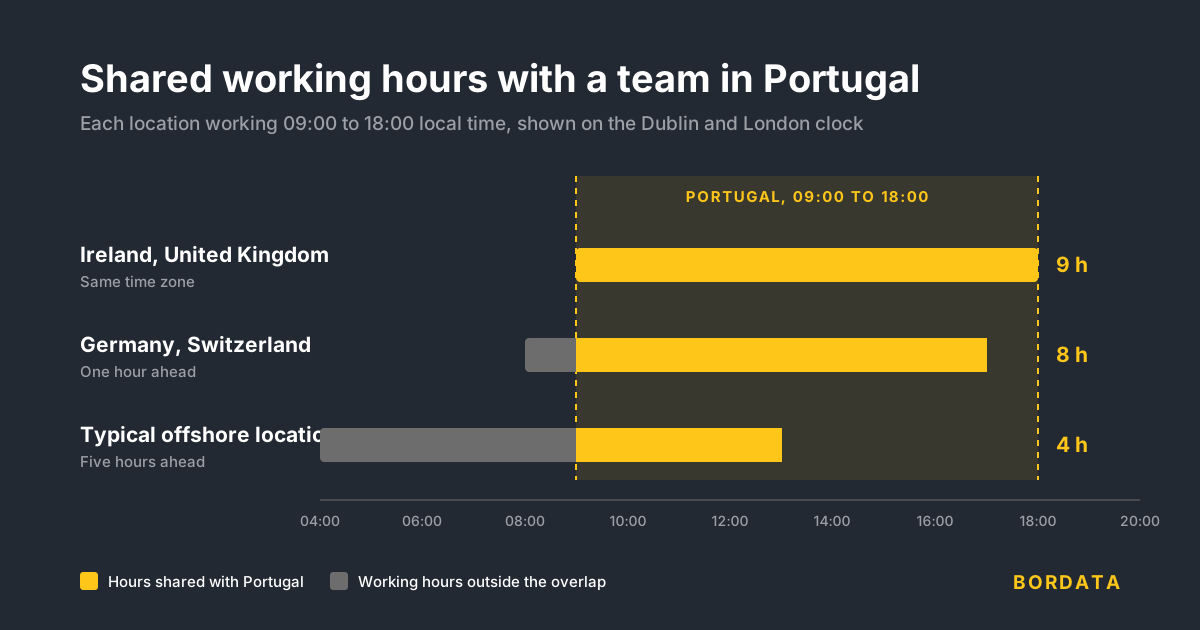
| Working from Portugal with | Time difference | Shared working day |
|---|---|---|
| Ireland, United Kingdom | None, all year | The full day |
| Germany, Switzerland, Netherlands, France | One hour | All but the first hour |
| A typical offshore location, for comparison | Four to six hours ahead of Dublin and London | About half the day |
Distance matters as well, because the important conversations still happen in person: the first workshop, the difficult steering meeting, the handover. A direct flight from Porto to Dublin takes about two and a half hours (Skyscanner ). A partner can be in your office in the morning and home the same evening, which makes being present a normal part of the engagement and not an exception that has to be budgeted.
What to check: ask how many hours of your working day the delivery team is online, and how often the senior people will be on site in the first three months.
2. Where will our data be processed, and under which law?
A data partner sees what most suppliers never do: the general ledger, payroll, customer records, claims, pricing. Where the people doing that work sit, and which law governs them, is an architectural question to settle at the start. It is not paperwork to produce at the end.
The position depends on where you are.
| Your business is in | A partner in Portugal is | What governs the data flow |
|---|---|---|
| Ireland, Germany, or another EU state | Inside the EU, under the same GDPR | No international transfer takes place |
| United Kingdom | In the EU, outside the UK | Adequacy decisions; the EU renewed its decision for the UK until 27 December 2031 (European Commission ) |
| Switzerland | In the EU, outside Switzerland | Adequacy; the Commission confirmed Switzerland’s status in January 2024 (Swiss FDPIC ) |
Many offshore locations have no adequacy decision. Work there can still be lawful, but it relies on contractual safeguards and a transfer assessment that your own team has to maintain and defend.
Jurisdiction is only half the answer. The stronger position is that the data does not move at all: the partner works inside your environment, with your access controls and your audit log, and nothing is copied out. Insurers and financial firms in the EU will also want to see how the arrangement fits their obligations on third-party ICT providers under DORA.
What to check: ask where each person with access is located, whether any data leaves your tenant, and who can prove what was accessed and when. Confirm the transfer position with your data protection officer; this article is not legal advice.
3. Who will do the work, and will they still be there next year?
The underlying problem is scarcity. In 2023, 57.5% of EU enterprises that recruited or tried to recruit ICT specialists had difficulty filling the vacancies (Eurostat ). A mid-market business competes for the same people as banks and technology firms, usually for a role too narrow to keep a senior specialist interested.
A partner solves that only if three things are true.
The people who scope the work are the people who do it. The common failure in outsourced data work is a senior person in the sales meeting and a different team in delivery. Ask for names.
They stay. The value of a data partner compounds. In year one they learn your chart of accounts, your exceptions and why two reports disagree. From year two they stop asking and start anticipating. Each change of team resets that. Our longest client relationship has run for more than eight years, and it is still active.
They work the way you work. Language is the first test. Portugal ranks sixth of 123 countries in the EF English Proficiency Index 2025 (The Portugal News ). Fluency is only the entry ticket, though. What matters is whether the partner can sit in your finance meeting, follow the argument about a number, and challenge it in your terms. That means working in your tools, to your reporting calendar and at your pace, and saying plainly when something is wrong.
What to check: ask who, by name, will be on your account in twelve months, and ask to speak to a client they have worked with for more than three years.
Where nearshore is the wrong answer
Nearshore is not the right model for every situation, and a partner who claims it is deserves some caution.
- You need a large team on site quickly. If the requirement is thirty people in your building next month, a local firm or a large integrator is the right call.
- The work must be done on your premises every day. Some environments are restricted to the site or require local security clearance. Regular visits do not replace daily presence.
- Daily work has to happen in a language other than English, across many users. Workshops with a wide group of German or French speakers need native delivery. Test that capability directly and do not assume it.
- Unit cost is the only criterion. For high-volume, tightly specified work where judgement matters little, offshore is cheaper and nearshore will not match it.
The model fits best where the work needs judgement, context and continuity: a small senior team working closely with your people over years.
Cost: a consequence, not the reason
Cost comes last not because it does not matter, but because it is the easiest thing to get wrong when comparing the three models. A wrong number in a board pack or a regulatory return costs more than any saving on a day rate.
There is a real difference. A senior team based in Portugal carries lower costs than the same team in Dublin, London or Munich, and part of that reaches the client. How much depends on the market: against some local rates the difference is material, against others it is modest.
We do not publish a percentage, because an honest one depends on what is being compared: the market, the seniority of the people and the type of firm. We would sooner give you a like-for-like comparison for your own case.
Two cautions for buyers:
- Compare seniority, not labels. A lower day rate for a less experienced person is not a saving. Compare what a named senior person costs in each model.
- Count the cost you carry yourself. Time lost to handovers, re-explanation and rework is real, and offshore models tend to move more of it onto your own team.
The fair summary of nearshore is: less expensive than local, but not cheap. If a proposal looks cheap, ask what has been left out.
Where Bordata fits
Bordata is a data and analytics consultancy based in Portugal, for European mid-market businesses that need to act on their data and defend the numbers afterwards. We advise on, build and automate the data platforms those businesses run on.
We reconcile every model back to source before we hand it over. That discipline comes from where our senior people started: as users of the reports, accountable for numbers they had not produced, before they built platforms for anyone else.
If you are weighing a local firm, an offshore team and a nearshore partner, we are glad to talk it through, including the cases where we would point you elsewhere. Thirty minutes is usually enough to tell whether the model fits your situation.
Write to José Almeida, founder, at [email protected] .